
Noticing (and) Sound: Reflections on an Arctic Amble
AudioSpaces
After our long break, it’s really good to begin sharing original writing with you beyond our regular newsletter. And what better way to reboot everything than with another piece from Sam. After his last [examination of archives](https://open.substack.com/pub/audiospaces/p/audiospaces-just-a-lil-archive?r=17m0u1&utm_campaign=post&utm_medium=web&showWelcomeOnShare=false), we get something a bit different: a short narrative of unexpected glaciers, croaking birch trees, wind-stricken microphones and literary realism.
I might be biased as I am literally a character in this story, but I do think—even beyond the crazy Scandinavian land and soundscapes—there are some really interesting reflections here. Hopefully they spark some inspiration in some of our AudioSpaces readers, listeners and recordists. There are two short recordings from the trip which you can listen to as you read, and then go on to find them on the AudioSpaces map. Enjoy!
Two friends and I recently went for a walk at the edge of the Arctic circle. Enough planning went into the logistics of the trip that meant our multiple stopped journey to the north of Sweden via Stockholm went without a hitch. Our flimsy paper guide was apparently waterproof, we had brought an epic amount of food mostly in the form of anonymous camping mush, we were all sufficiently gorp’ed up and every bunion had been massaged well in advance. We thought we were prepared for every event.
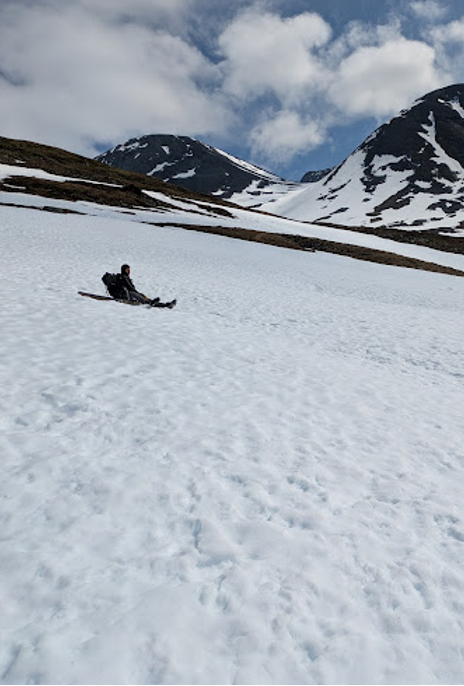
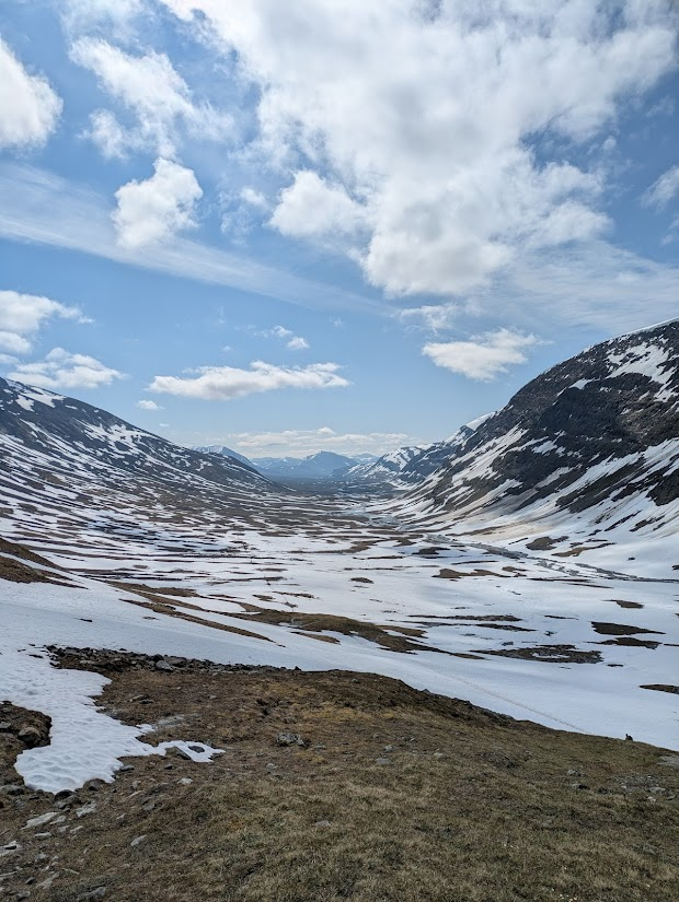
It was with Ollie and Dylan that I hiked. Ollie is the part-time Swede and full-time optimist whose idea it was to walk this route. His very understandable logic was that if we went in summer then there wouldn’t be any snow. How can you argue with that? We gave no more thought to the prospect until the immediate days before our first flight when we discovered we would be walking in between glaciers. On the third day of the trip, we walked for about five kilometres up and over a snow-laden peak in blistering sunshine before Ollie blew up his ultralite inflatable camping mattress and sledged part way down the other side.
A German man in an expensive down coat with a pair of comically large pit vipers laughed at us as he filmed Ollie slide. Our faces were burnt and our feet were wet; Dylan was worried he might have permanently damaged his retinas. Between us we had one pair of sunglasses.
[
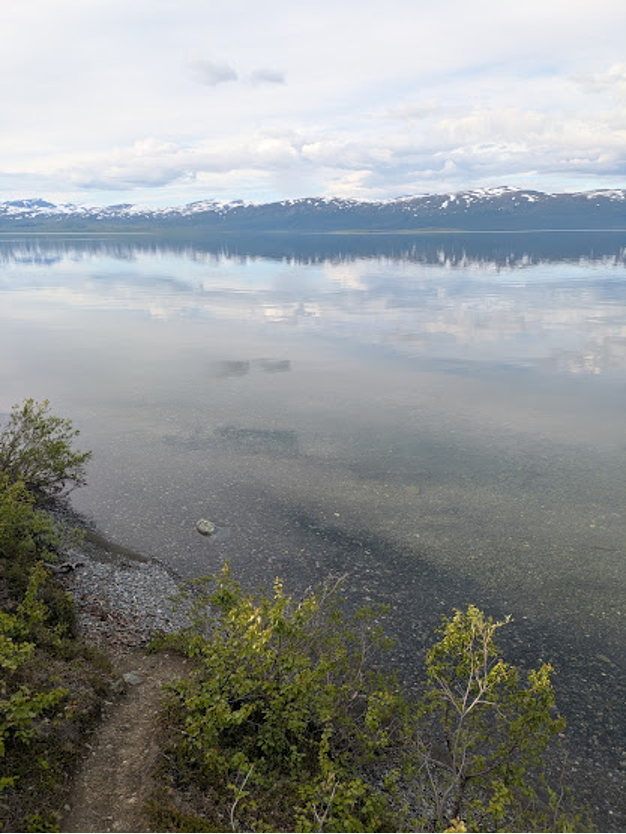
](https://substackcdn.com/image/fetch/$s_!t7j3!,f_auto,q_auto:good,fl_progressive:steep/https%3A%2F%2Fsubstack-post-media.s3.amazonaws.com%2Fpublic%2Fimages%2F15ffc7a1-17ae-4690-87d3-58fd7aa0d9d5_464x686.png)For our initial night in Lapland we stayed at a Svenska Turistföreningen hostel on the edge of the glacial Torneträsk which happens to be the sixth largest lake in Sweden. Naturally we had to dip in the sauce and so we followed a brook down to its shore. From the beach the lake looked like a sheet of flattened molten glass. There was no wind, no ripples, barely any trees to shed leaves; we saw no wildlife apart from small birds and there was barely any evidence of human activity apart from a rustic sauna hut along the coast that lay empty. It felt like we were the first people to ever wade into its waters.
Standing on the beach I was suddenly overwhelmed by the amount of empty space. I had never been in wilderness like this. We were the only creators of sound. Behind us was a hill of dense springy moss and brush that absorbed even the idea of an echo so if you screamed the waves would have nowhere to travel (although, at one point a group of clearly confused and twitchy Spaniards walked past which made me wonder about the validity of our theory). In every other direction was rolling vegetation or water with no obvious evidence of any human or even animal tampering. Could it really be that somewhere so lush could be so barren?
[
](https://substackcdn.com/image/fetch/$s_!9kO6!,f_auto,q_auto:good,fl_progressive:steep/https%3A%2F%2Fsubstack-post-media.s3.amazonaws.com%2Fpublic%2Fimages%2F9101f68d-08e4-4152-a094-143d93b010b3_626x834.png)Deeper into the wilderness we were repeatedly surprised by the sparseness of the terrain, especially during the middle three days where the land was the leanest. At this point we went above the Arctic tree line where trees are unable to grow due to intolerable conditions. One evening Dylan whipped out his field recorder and a pair of omnidirectional microphones to see if we could hear what we couldn’t see. Up to this point in my life I had never intentionally listened to recorded sound through omnidirectional microphones nor known that they even existed; and, to be honest, I had thought Dylan’s decision to bring such luxuries on a massive hike was questionable. How wrong I was.
[
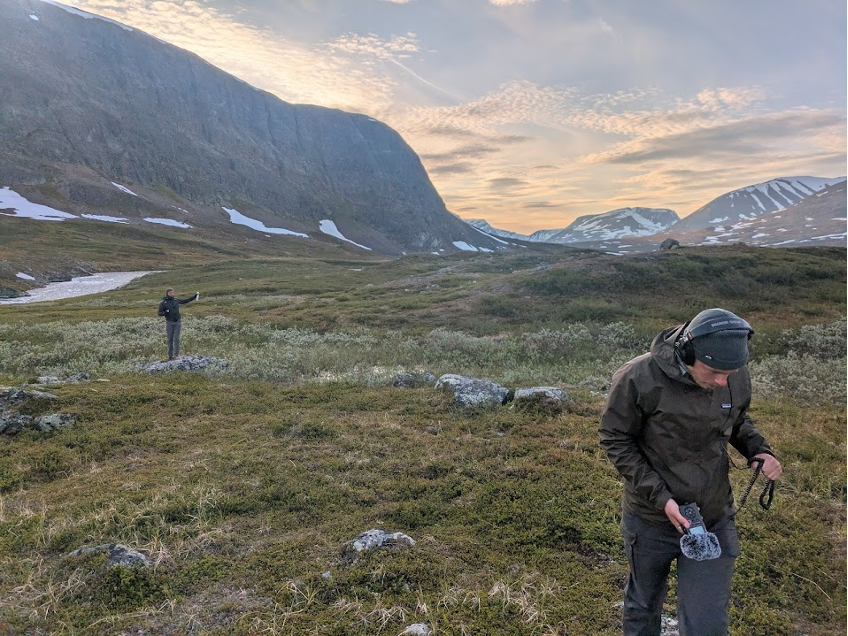
](https://substackcdn.com/image/fetch/$s_!vz1R!,f_auto,q_auto:good,fl_progressive:steep/https%3A%2F%2Fsubstack-post-media.s3.amazonaws.com%2Fpublic%2Fimages%2F5879439b-9bb2-49ac-a7d0-5f698c7c433e_848x636.png)Click here to listen to this sound on the map!By facing the recorder towards bushes we thought we might catch the chatter of some off-duty lemmings, or maybe the humble bark of an Arctic fox, but it was to no avail. Listening through headphones I thought I was hearing nothing of note. The Arctic tundra is a vacuum after all.
I walked further onwards following my ears whilst Ollie made sounds by snapping sticks on rocks and rustling empty salted peanut packets around me at varying distances. I could hear the thrashing of a river and the wet gurgling of our boots pulling and pushing in bog, two of the ubiquitous soundmarks of our trip.
Ollie discovered an eerie scene underneath a large overhanging slab of rock in which a set of tattered camping gear including two discarded coats, ripped clothes, a sleeping bag, a battered tin cooking pot and unused firewood lay untouched and covered in earth and debris. We pointed the mics in this direction to see if we could hear any wailing ghosts. Instead we were shooed away by the wind.
We heard nothing obviously exciting, yet for some reason I was overstimulated, exhilarated and, therefore, confused. I didn’t want to take off the headphones. Why should the panning of such prosaic and undramatic noises through my head make me feel like baby Julian?
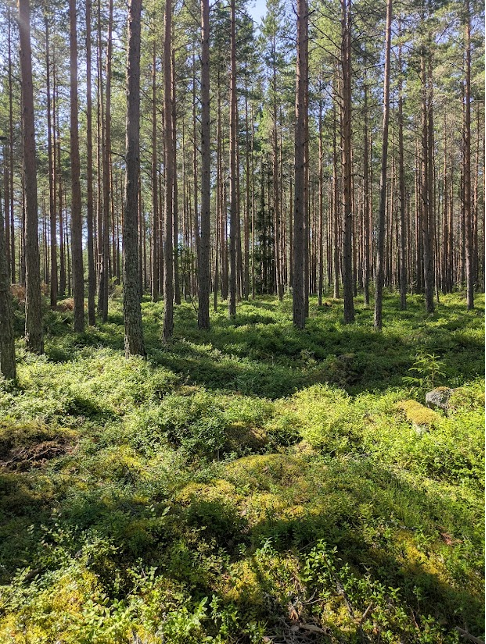
After our walk in Lapland, we travelled south to the middle of Sweden and stayed in a house surrounded by birch forest. We picked chanterelle mushrooms and ate sweet wild strawberries and swam in lake Vänern which made Torneträsk look like a puddle. On the second day here Dylan took his omnidirectional mics to the woods and we took it in turns to listen as we stumbled through knots of spongy undergrowth. This time we drowned in sound.
I was on set with David Attenborough. Fat bees were orbiting. I heard the crunching of sticks by unknown animal hoofs in the far distance and the creaking and groaning of birch trees as they fought for light. A flock of birds warned one another about the humans invading their homes. I was witnessing the classic fan-made Buckie High video first hand. A thick furry trapper hat was removed that I hadn’t known was there: I was really hearing for the first time!
[
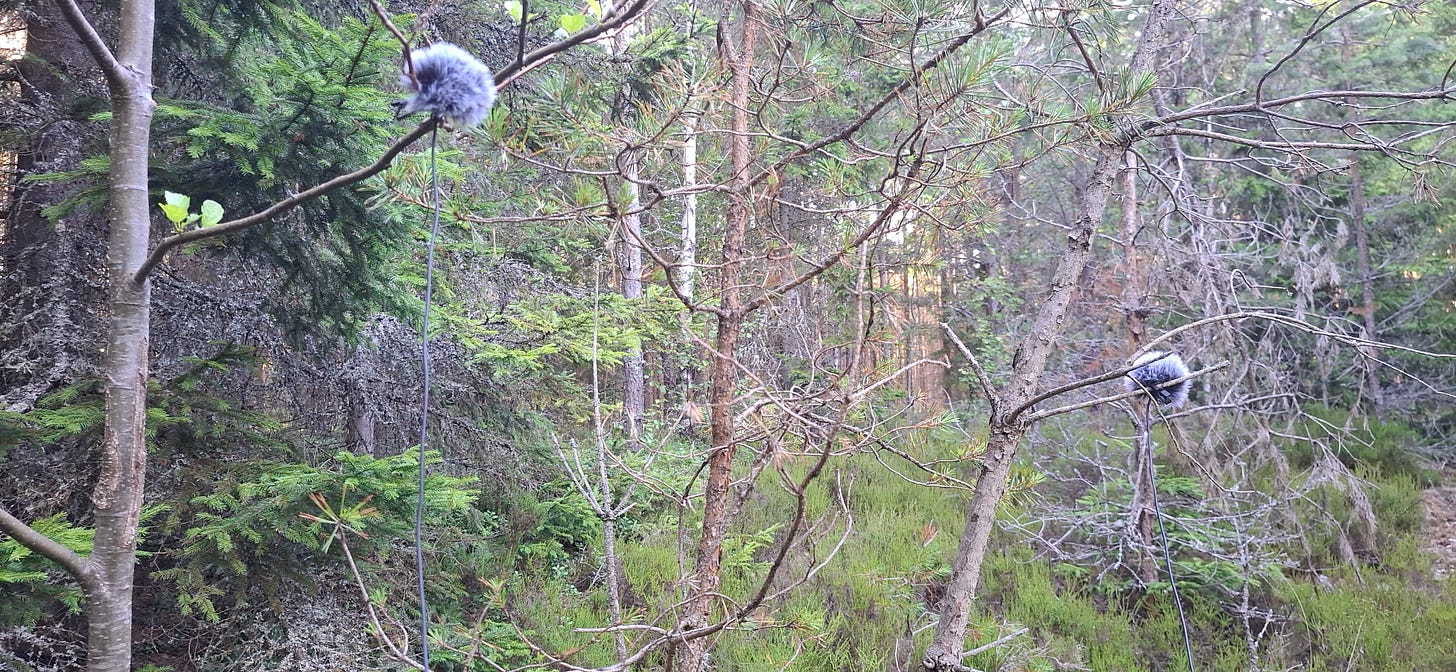
](https://substackcdn.com/image/fetch/$s_!VtM8!,f_auto,q_auto:good,fl_progressive:steep/https%3A%2F%2Fsubstack-post-media.s3.amazonaws.com%2Fpublic%2Fimages%2F65753a42-8300-4723-b3ef-13c6555c6de4_4080x1884.jpeg)Click here to listen to this sound on the map!This all might seem slightly over the top, and maybe it is, but this felt to me like an entirely new sensation. A world so vivid was conjured up in my head that I felt like I could have confidently walked from one end of the forest to the other unobstructed with my eyes closed using just the mics. Later on we took turns listening back to the forest recordings on the wooden decking outside the house and again I was put under the sonar spell.
As I’m a simple aural philistine I’ll let someone else explain more thoroughly and scientifically why binaural recording (using two microphones to record in a certain way as we did) is so immersive and effective in capturing organic sound, but I am still interested in trying to understand in different terms what made this such an exciting experience.
The ability to notice is one of the most important skills in the armoury of an artist, whatever their medium may be. I’ve found that there are certain writers whose capacity for noticing (and skill in conveying what they notice) has rewired my brain.
[

](https://substackcdn.com/image/fetch/$s_!GcCZ!,f_auto,q_auto:good,fl_progressive:steep/https%3A%2F%2Fsubstack-post-media.s3.amazonaws.com%2Fpublic%2Fimages%2F0867dbcb-7d07-4ce8-a682-beead637cbb3_588x782.png)For instance Raymond Carver’s masterful ability is to bury a story in its subtext. He is the king of implying, or alluding to, rather than telling. It’s up to the reader to deduce what is at the story’s core as the feelings and desires of his characters are couched in such short, tight, simple language. That said, Carver’s characters are so vivid precisely because he notices the microscopic actions that betray their intentions. Every time you reread What We Talk About When We Talk About Love you’ll find more depth as you notice more little golden nuggets about each of the four characters.
Similarly, A M Homes is another writer who really sees her characters. Homes says that she considers herself a science fiction writer in that her stories test the logic of everyday life to the point of fantasticality and/or destruction, although she would likely also argue that life is already fantastical and she just notices it for what it is. She explores the interiority of some deeply unsavoury people with the precision of a psychoanalyst. Again, a supreme noticer and understander of the psyche.
Both writers are known for their “quotidian realism” which basically means that they write about (seemingly) everyday interactions, settings, events, objects, conversations, people. This is reflected in the fact that they usually set their stories in anonymous suburban North American towns that all feel uncannily similar.
[
](https://substackcdn.com/image/fetch/$s_!8xUq!,f_auto,q_auto:good,fl_progressive:steep/https%3A%2F%2Fsubstack-post-media.s3.amazonaws.com%2Fpublic%2Fimages%2F27137817-64eb-400b-9055-9457ae05948c_486x644.png)Anyway, the reason I bring up this idea of noticing and specifically these two writers is because whilst listening to the world through the omnidirectional microphones I get a similar feeling to when I read stories by Carver and Homes. There’s hearing a forest, and then there’s listening to the forest cosmos through these mics. There’s reading a story about parents who need time alone away from their children, and there there’s reading Adults Alone by A M Homes.
Omnidirectional mics aim to capture sounds equally from every direction and are therefore a great tool for noticing. They seem to override the human tendency to selectively hear and do not present our brain with a hierarchy of sound in the way that our ears do. Carver and Homes too recognise and transcend the hierarchies and inevitabilities of ordinary life by noticing in every direction. Like the mics, they recontextualise the quotidian to allow the listener/reader to reconsider something they might have originally thought was plain or two dimensional.
In Sweden we listened to noises that up to that point I had considered “normal”, maybe even uninteresting. They were noises that had been occurring in those places for thousands of years. Yet listening to them so acutely and equally made me think about the story of the place, it made me realise that all these noise-makers had lives and chaotic histories like we do. Does this make me some kind of hippy?
With a deeper, more intentional listening you might just hear the subtext.
[
](https://substackcdn.com/image/fetch/$s_!KD8M!,f_auto,q_auto:good,fl_progressive:steep/https%3A%2F%2Fsubstack-post-media.s3.amazonaws.com%2Fpublic%2Fimages%2Ffb4ea39a-8b4e-4c4a-ada3-4d594765d6ee_680x902.png)We also didn’t see the sun set for a week...https://www.spencerbruce.com/blog1/2023/8/15/capturing-the-sonic-landscape-a-guide-to-binaural-field-recording-methods-and-techniques – Neil Bruce’s words on binaural recording.
https://tnsatlanta.org/wp-content/uploads/What-We-Talk-About-When-We-Talk-About-Love-Carver.pdf – the mentioned Raymond Carver story.
https://bombmagazine.org/articles/1996/04/01/a-m-homes/ – introduction to the world of A M Homes.
https://lithub.com/james-wood-what-is-at-stake-when-we-write-literary-criticism/ – introduction to Serious Noticing by James Wood, a principal inspiration for this article.
Thanks for reading! If there’s someone else you think would enjoy this aural-literary excursion then feel free to pass it on.